
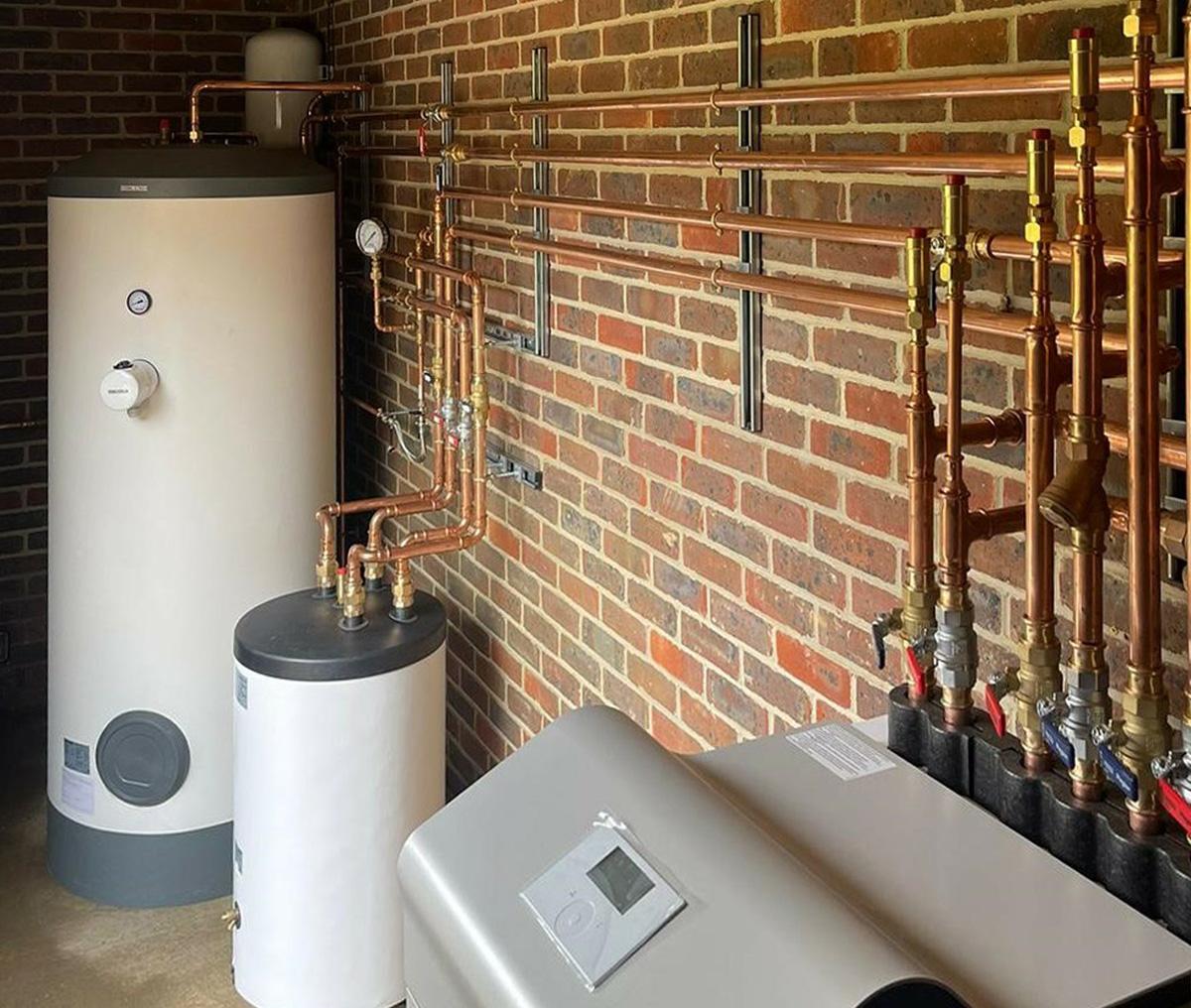
A ground source heat pump doesn't make heat by burning anything. It collects low-temperature warmth that is already stored in the ground and concentrates it into heat that is useful for your home.
For every 1 kWh of electricity it uses, a well-designed system typically delivers 3.5 to 5.5 kWh of heat. The rest comes free from the ground beneath your feet.
Here's how it works, step by step, following the heat from the borehole to your radiators.
1Collecting heat from the ground
The ground in the UK stays at a steady temperature of roughly 10°C all year round.
To tap into this, we drill boreholes, usually around 100 to 200m deep, and install a sealed loop of pipe in each one. A mix of water and antifreeze (often called brine or glycol) is pumped through the loop.
As it travels down and back up, the fluid picks up warmth from the surrounding rock. In winter it typically returns to the heat pump at around 5 to 10°C. That doesn't sound warm, but it's more than enough for the next step.
2The evaporator
Inside the heat pump, the ground loop fluid flows through a heat exchanger called an evaporator. On the other side of a thin metal wall is a refrigerant: a special fluid that boils at a very low temperature, well below 0°C.
Because the refrigerant is colder than the ground loop fluid, heat flows into it. The refrigerant boils and turns from a cold liquid into a cold gas, soaking up energy as it does so.
Having given up some of its warmth, the ground loop fluid leaves the evaporator around 3°C cooler and heads back down the boreholes to be warmed up again. This loop runs continuously while the heat pump is working.
3The compressor turns up the temperature
The refrigerant gas is now carrying the ground's heat, but it is still only a few degrees above freezing, far too cool to heat a home.
This is where the compressor comes in; it is the heart of the heat pump and the main part that uses electricity. It squeezes the gas into a much smaller space; squeezing the gas makes it hot, just like a bicycle pump getting warm as you use it.
The refrigerant leaves the compressor as a hot, high-pressure gas at roughly 60 to 80°C. The low-temperature heat from the ground has now been upgraded to a usable temperature.
4The condenser delivers heat to your home
The hot refrigerant gas now flows through one side of a second heat exchanger, the condenser, while your heating system's water runs through the other side and heat is exchanged between the two.
As the refrigerant hands its heat over to the heating system water, it cools down and turns back into liquid. The heated water leaves the heat pump at the temperature your home needs:
- Underfloor heating: around 35 to 40°C
- Radiators: around 45 to 50°C, with larger radiators sized to suit
- Hot water cylinder: around 50 to 55°C, with a periodic higher-temperature cycle for hygiene
The lower the flow temperature, the more efficiently the heat pump runs. That's why underfloor heating and generously sized radiators are such a good match for a ground source system.
Back to the start
The refrigerant, now a warm liquid under high pressure, passes through an expansion valve. This releases the pressure suddenly, dropping the refrigerant back to well below freezing. It returns to the evaporator ready to collect more heat from the ground and the whole cycle repeats.
Why good design matters
A ground source heat pump is only as good as the ground loop behind it. Too few or too shallow boreholes and the ground cools down, the loop temperatures drop and efficiency falls.
Every Nicholls system starts with a proper heat loss calculation for the building followed by borehole sizing based on a detailed analysis of the local geology. Getting these right means a system that stays efficient for its lifetime.